Training & Career · 23 July 2026 · 6 min read
PMU Marketing Rules UK: Before-and-After Ads, Claims and Reviews
Market PMU services confidently without risky claims: a UK guide to before-and-after images, client consent, social ads, reviews and promotions.
By Powdrr Academy, PMU Education & Business Team
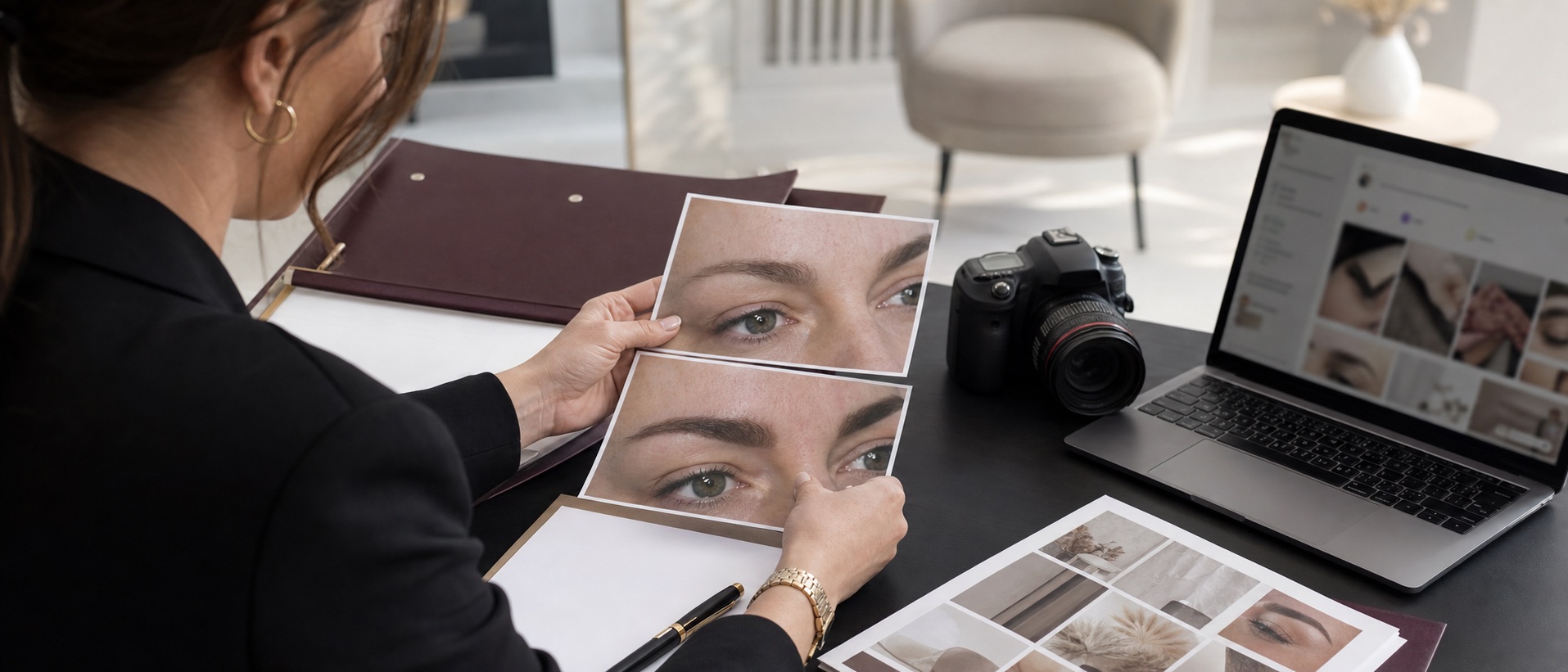
Good PMU marketing reduces uncertainty. It shows the artist’s real work, explains who a treatment may suit, sets honest expectations and gives the client a clear next step. It does not need fear, shame or impossible promises.
A useful rule: if the overall impression would make a reasonable person expect a result you cannot evidence, add context or change the claim. A disclaimer cannot rescue a misleading headline or image.
The UK Advertising Codes can apply to paid ads, websites, promotional posts and an artist’s own social channels. The ASA’s cosmetic interventions guidance is a useful starting point. This article is general marketing guidance, not legal advice.
Before-and-after images that inform rather than distort
PMU imagery is powerful evidence, so document it consistently:
- Use the same angle, distance, crop and broadly comparable lighting.
- Avoid beauty filters, skin smoothing and edits that change the apparent result.
- Label immediate, healed and top-up results accurately.
- Explain when redness, swelling, colour intensity or healing is visible.
- Do not suggest one client’s result is typical if outcomes vary materially.
- Keep the underlying dated, consented case record.
“Healed at eight weeks after one initial treatment and one review appointment” is more useful than “perfect brows”. Read the before-and-after photography guide for a repeatable set-up.
Treatment consent is not marketing consent
A client can agree to a treatment without agreeing to appear online. Make image use a separate, specific choice. Explain the channels, whether the face will be identifiable and whether the client can withdraw consent for future use. Refusing marketing should not affect the treatment or price.
Store the permission with the actual assets and record any later change. Do not rely on “she said it was fine in the room” once an image is scheduled across several platforms. Our GDPR and PMU client-record guide covers data protection in more detail.
Claims that need evidence or qualification
| Risky wording | Why it is risky | More useful direction |
|---|---|---|
| Permanent, pain-free or risk-free | Absolute promises ignore variability and known treatment considerations | Explain intended longevity, comfort approach, risks and individual variation |
| Best artist in the city | Objective superiority needs robust evidence | Describe verifiable training, style, experience and client process |
| Hypoallergenic or toxin-free | Technical health or product claims require substantiation and context | Use supplier-supported terminology and avoid broad safety guarantees |
| Fixes asymmetry or restores confidence | Can overstate outcomes or exploit insecurity | Describe the cosmetic goal and consultation process without guaranteed emotional benefit |
| Only two spaces left | Misleading scarcity creates unfair pressure | Use genuine availability and give clients time for an informed decision |
The ASA’s beauty and cosmetics guidance explains that objective claims need evidence and that before-and-after imagery can itself communicate a claim.
Social responsibility and audience
Cosmetic marketing should not exploit insecurities or present a procedure as the only route to social, professional or romantic success. Be especially careful with content about ageing, hair loss, facial difference or self-esteem. The ASA’s social-responsibility guidance gives examples of the concern.
Micropigmentation is within the scope of the CAP Code restrictions on targeting cosmetic-intervention advertising to under-18s. Check the current rules and the targeting controls of each platform before running a campaign.
Reviews and testimonials
Use genuine experiences from real clients and keep permission where you republish a review. Do not edit a testimonial so heavily that its meaning changes. Avoid presenting a personal health outcome as evidence that everyone will obtain the same result.
Google prohibits offering free or discounted products or services in exchange for reviews, review changes or the removal of negative reviews. Ask consistently for honest feedback instead. Link directly to the review form after an appropriate point in the client journey and follow Google’s official review guidance.
Promotions, prices and influencers
- From prices: ensure a meaningful proportion of clients can obtain the advertised price and explain mandatory extras.
- Discounts: compare with a genuine usual selling price, not an invented anchor.
- Deposits: show material booking, cancellation and refund terms before payment.
- Countdowns: do not restart a deadline or manufacture urgency.
- Gifts and influencers: disclose commercial relationships clearly and upfront.
A consultation should be a suitability decision, not a pressure device. Avoid “book tonight before your free consultation expires” structures around an invasive cosmetic treatment.
A practical content approval workflow
- Identify the claim. Consider the words, image, audio, caption and destination page together.
- Find the evidence. Keep product documentation, dated client records and the basis for measurable claims before publishing.
- Check permission. Match every identifiable case asset with separate marketing consent.
- Add essential context. State whether imagery is immediate or healed and describe important limitations.
- Review the audience. Check targeting, tone and whether the ad exploits insecurity.
- Archive the version. Keep the creative, caption, evidence and publication date.
This process helps a solo artist make consistent decisions and gives a growing team a clear approval trail.
Frequently asked questions
Can PMU artists use before-and-after photos in ads?
Yes, with appropriate client permission and provided the overall impression is truthful. Use consistent photography, avoid misleading edits and label immediate or healed stages accurately.
Can I say a PMU treatment is pain-free?
An absolute pain-free claim is risky because comfort varies. Explain your process without promising that no client will experience discomfort.
Can I offer a discount for a Google review?
No. Google prohibits incentives in exchange for reviews, review changes or removal of negative reviews. Ask genuine clients for honest feedback without attaching a reward.
Do I have to label gifted influencer treatments?
Commercial relationships, including gifts, can require clear ad disclosure. Check current ASA and platform guidance and ensure the label is prominent rather than hidden among hashtags.
Your next step
Audit your last 20 posts using the six-step workflow. Correct any unsupported absolutes, unclear healed-result labels or missing permissions, then build the next month of content with the 90-day PMU business plan.
Frequently asked questions
Can PMU artists use before-and-after photos in ads?
Yes, with appropriate permission and a truthful overall impression. Use consistent photography, avoid misleading edits and label healing stages.
Can a PMU artist say treatment is pain-free?
An absolute pain-free claim is risky because comfort varies. Explain the process without promising no discomfort.
Can I offer a discount for a Google review?
No. Google prohibits incentives in exchange for reviews, review changes or removal of negative reviews.
Do gifted PMU influencer treatments need an ad label?
Commercial relationships, including gifts, can require clear disclosure. Check current ASA and platform guidance.