PMU Knowledge · 23 July 2026 · 6 min read
UK REACH PMU Pigment Rules 2026: What Artists Should Do
Understand the 2026 UK REACH decision on tattoo and PMU pigments—and the supplier, label, batch and stock records prudent GB artists should review now.
By Powdrr Academy, PMU Education & Business Team
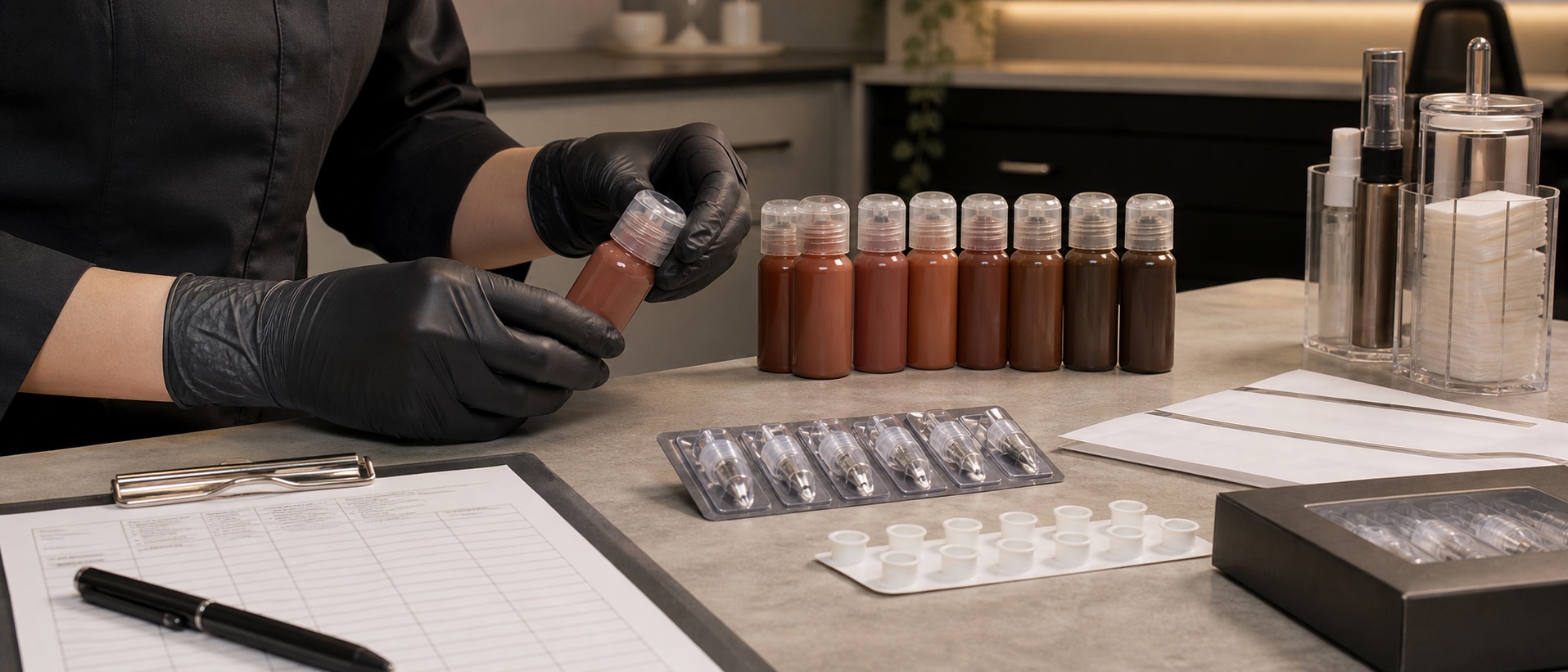
The UK Government published its decision on a proposed UK REACH restriction for substances in tattoo inks and permanent makeup in January 2026. For artists, the practical message is not to guess a future ban list. It is to strengthen supplier checks, product documentation, labelling, traceability and stock control while following the legal commencement process.
Status matters: the published decision and draft amendment describe a planned restriction for Great Britain. Do not treat a proposal, decision document and in-force legal requirement as interchangeable. Check the current legislation and commencement date before making a definitive compliance claim.
This article summarises operational preparation, not legal advice or a product approval. The authoritative starting point is the Government’s UK REACH decision and draft amendment.
What the 2026 decision means
The decision concerns hazardous substances in inks placed into the skin for tattooing and permanent makeup. The policy intention is to reduce health risks through concentration limits and related information requirements. A draft statutory amendment accompanied the decision.
Because legislation moves through formal steps, artists should track:
- when the statutory instrument is made;
- the legal commencement and transition provisions;
- whether later amendments or guidance change the draft position;
- the territory in which the product is supplied and used;
- any insurer, council or supplier conditions that apply sooner.
Great Britain and Northern Ireland can sit within different chemicals frameworks. An artist should not assume a product acceptable in one market has identical status in the other.
Build a pigment evidence file
For every pigment line, create a supplier evidence file. Ask the manufacturer or authorised distributor for documentation that is current, product-specific and relevant to the market in which you work.
| Evidence | What to check | Record action |
|---|---|---|
| Supplier identity | Legal business, contact details, market role and traceable purchase route | Keep invoices and supplier correspondence |
| Product identification | Exact range, shade, product code and intended PMU use | Match document to bottle and catalogue entry |
| Safety and compliance statement | Territory, regulation referenced, version date and any limitations | Store the source document, not only a screenshot of a claim |
| Label | Ingredients or required information, batch, expiry or use-by, warnings and manufacturer details | Photograph each received batch if useful |
| Handling instructions | Storage, opening, contamination prevention and disposal | Translate into stock and treatment-room procedures |
A claim such as “REACH compliant” is only useful when it states which regulation, territory, version, product and evidence it refers to. Do not rely on a reseller badge with no underlying documentation.
Record batch traceability at treatment level
Powdrr’s PMU Bible treats product recording as part of client safety. Your client note should make it possible to identify what was implanted if a recall, supplier alert, unexpected reaction or quality question arises.
Record the manufacturer, range, shade, lot or batch, expiry where shown, date opened if relevant and the way shades were mixed. Keep the purchase route and supplier documentation linked to that inventory. The record should be clear enough for another competent person to follow.
Batch traceability complements—not replaces—consultation, contraindication screening, hygienic practice and appropriate response to concerns. See what PMU consultation records should contain.
Review existing stock without panic or waste
- Create an inventory of every open and unopened bottle.
- Separate expired, damaged, unlabelled or untraceable products immediately from usable stock.
- Match each range and shade with supplier evidence and invoices.
- Ask the supplier how the UK decision affects current and future batches.
- Record the answer, source and date; do not rely on a disappearing social-media story.
- Set a review date around confirmed legislative milestones and supplier updates.
- Dispose of unsuitable products through an appropriate route rather than domestic guesswork.
Do not decant pigments into unlabelled containers or create a private stock code that loses the original batch link. Do not assume an unopened bottle remains appropriate merely because it is in date.
Questions to ask a pigment supplier
- Which legal entity manufactures the product and who places it on the GB market?
- Which current GB or Northern Ireland requirements does the statement address?
- Does the evidence cover this exact shade and batch?
- What label and ingredient information should accompany the bottle?
- How will customers be notified of a recall, reformulation or document update?
- Are there storage, mixing or expiry limitations?
- Can the supplier provide the statement in a durable document?
A competent supplier should welcome specific questions. If evidence is vague, contradictory or tied to another market, pause purchasing and seek clarification.
Compliance paperwork does not choose a pigment
Regulatory evidence does not tell an artist which pigment is suitable for a client. Colour selection still requires training in skin, undertone, healed behaviour, technique, depth and the specific product system. Product families behave differently, and marketing labels such as “organic” or “inorganic” do not, on their own, determine safety or healed outcome.
Revisit colour theory for permanent makeup and organic versus inorganic PMU pigments. Follow manufacturer instructions and work within your trained competence.
If a client reports a reaction or concern
Take the concern seriously, document what is reported and retrieve the exact treatment and batch record. Do not diagnose or prescribe beyond your qualifications. Follow your insurer’s incident process and signpost urgent or concerning symptoms to appropriate medical assessment. Preserve the relevant product and evidence if safe to do so, and check for supplier or official alerts.
Frequently asked questions
Are UK REACH PMU pigment restrictions already in force?
The Government published a decision and draft amendment in January 2026. Check the current legislation and commencement provisions before stating that the planned restriction is in force.
Is an EU REACH-compliant pigment automatically compliant in Great Britain?
Do not assume equivalence. Ask for product-specific evidence against the legal requirements applying in the market where the pigment is supplied and used.
What pigment details should a PMU artist record?
Record enough to trace the exact product, commonly including manufacturer, range, shade, batch or lot, relevant expiry or opened date, supplier and any mixture used.
Should I throw away all current pigments?
Not simply because a decision was published. Inventory the stock, isolate expired or untraceable products, obtain supplier evidence and act according to current law, official guidance and professional conditions.
Your next step
Schedule a one-hour stock audit. Match every bottle to a supplier, batch, document and client-record field, then subscribe to updates from the relevant official bodies and suppliers. Build the process into the PMU artist starter checklist.
Frequently asked questions
Are UK REACH PMU pigment restrictions already in force?
The Government published a decision and draft amendment in January 2026. Check current legislation and commencement provisions before saying the planned restriction is in force.
Is an EU REACH-compliant pigment automatically compliant in Great Britain?
Do not assume equivalence. Obtain product-specific evidence for the requirements applying in the market where it is supplied and used.
What pigment details should a PMU artist record?
Record enough to trace the exact product, including manufacturer, range, shade, batch or lot, relevant dates, supplier and mixtures.
Should PMU artists throw away all current pigments?
Not simply because a decision was published. Audit stock and evidence, isolate expired or untraceable products, and act on current legal and professional requirements.