Training & Career · 23 July 2026 · 6 min read
A Day in the Life of a PMU Artist: The Honest Version
What does a permanent makeup artist really do all day? See an honest sample schedule covering clients, consultation, cleaning, records and business work.
By Powdrr Academy, PMU Education & Business Team
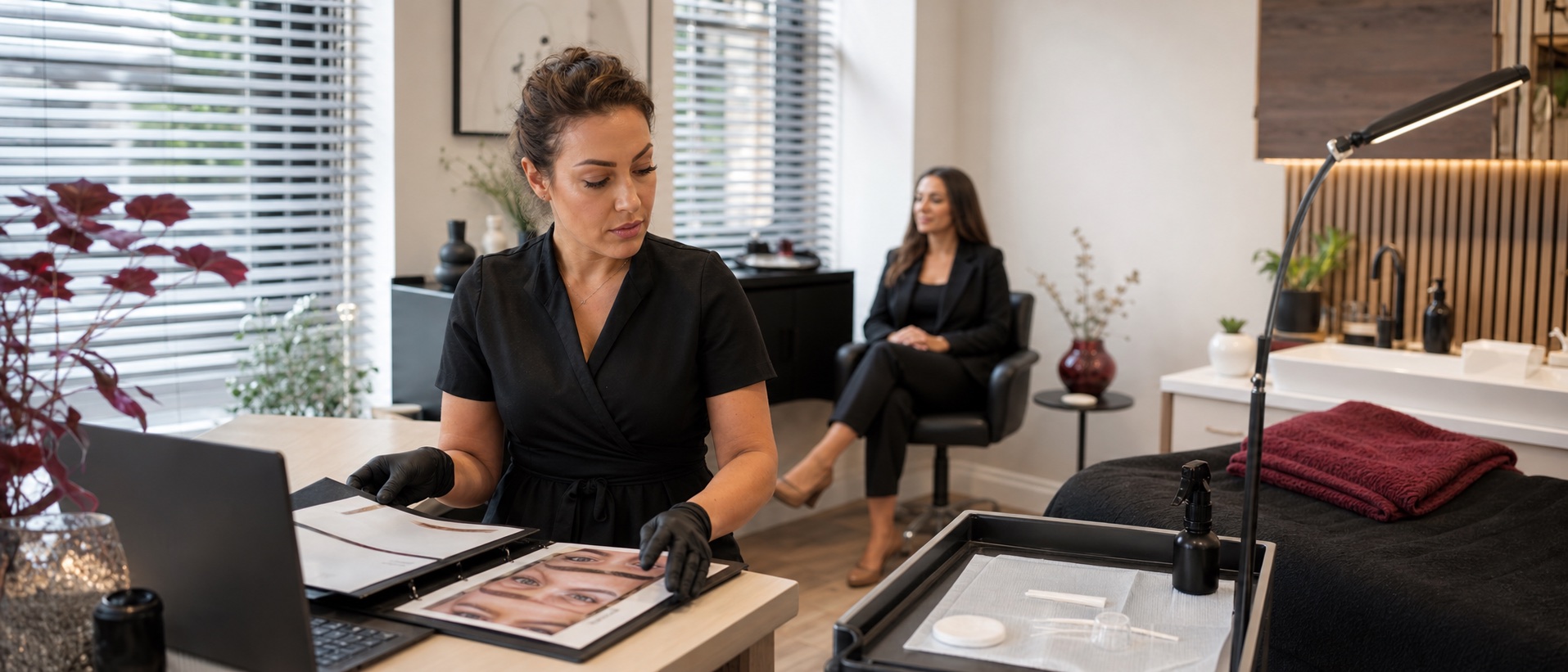
The visible part of permanent makeup is the treatment. The professional part is everything that makes the treatment appropriate, safe, traceable and supported: consultation, preparation, records, cleaning, photography, aftercare, learning and running the business.
The honest version: a sustainable PMU diary is not a row of back-to-back transformations. It includes protected time before and after each client, plus regular business and professional-development work.
The schedule below is illustrative. Treatment length and working pattern vary by procedure, competence, client, room and business model.
An illustrative PMU client day
| Time | Activity | What is really happening |
|---|---|---|
| 08:30 | Room and records check | Review diary, prepare controlled environment, confirm stock, messages and client information |
| 09:00 | Consultation and mapping | Reconfirm health information, suitability, goals, consent, shape and colour plan |
| 10:00 | Treatment | Work within agreed plan while monitoring comfort, skin response, hygiene and product traceability |
| 12:00 | Photos, notes and aftercare | Complete batch details, record outcome, explain care and confirm how concerns are handled |
| 12:30 | Clean-down and reset | Dispose, decontaminate, replenish and prepare without cross-contamination |
| 13:15 | Lunch and messages | Respond to suitable enquiries without conducting diagnosis in direct messages |
| 14:00 | Review or second appointment | Assess healing or repeat the full client pathway for another service |
| 17:00 | Close and follow-up | Secure records, reconcile payments, check stock and schedule client support |
A treatment that appears as a two-hour calendar block may occupy more capacity once consultation, set-up, clean-down and follow-up are included. This matters for pricing and for preventing rushed records.
Consultation is part of the craft
A PMU artist does not simply reproduce a reference photo. The artist explores the client’s goal, relevant history, skin presentation, existing work, facial features, likely healing, maintenance commitment and whether treatment should proceed. Sometimes the best professional outcome is to postpone or decline.
Mapping and colour planning are collaborative, but the artist still owns professional boundaries. Powdrr’s PMU Bible emphasises informed decision-making: the client’s preference, the artist’s competence and safe suitability all need to align. Read the consultation forms guide and PMU colour theory guide.
Treatment demands physical and mental focus
Artists maintain posture and fine motor control while observing skin response, pigment behaviour, device performance, symmetry, client comfort and hygienic boundaries. This is why realistic scheduling, lighting, magnification, seating and breaks matter.
Working faster is not automatically more advanced. Efficiency comes from organised preparation and repeatable decisions, not skipping consultation or compressing clean-down. Ergonomic strain and fatigue can affect both artist and client, so working capacity should be built gradually.
The invisible work behind each appointment
- Screening enquiries and explaining suitability.
- Keeping consultation, consent, batch and treatment records.
- Ordering traceable stock and checking documents, expiry and storage.
- Cleaning, waste management and room maintenance.
- Booking, deposits, reminders, accounts and tax records.
- Editing and publishing consented, truthful case content.
- Following up healing and responding to concerns.
- Practising, reviewing cases and completing continuing professional development.
These tasks are not evidence that the business is inefficient. They are part of the service and should be reflected in capacity and pricing.
What happens on a non-client day?
A well-run artist may use a non-treatment day to reconcile accounts, deep-clean and audit stock, update client resources, photograph the room, review healed cases, practise patterns, attend education, write a useful local article and build referral relationships.
It is also the right time to review what the diary is saying. Which enquiries are suitable? Where do clients hesitate? Are follow-ups happening? Which procedure creates disproportionate rework? The 90-day PMU launch plan includes a simple weekly scorecard.
Part-time and full-time realities
Part-time can be a deliberate, professional model. It lets a new artist build cases and systems while retaining other income. The risk is squeezing clients into evenings without enough time for records, cleaning or follow-up.
Full-time does not need to mean treating five days a week. The business may need protected administration, marketing and learning time. Judge the model by safe capacity, sustainable profit and client experience—not the number of diary blocks.
Skills PMU artists use beyond technique
- Communication: translating technical choices into an informed client decision.
- Judgement: recognising limits and deciding when not to treat.
- Observation: reading symmetry, skin, healing and product behaviour.
- Organisation: maintaining sterile workflow, traceability and records.
- Emotional steadiness: handling nerves, expectations and concerns without becoming defensive.
- Commercial thinking: pricing full capacity, measuring enquiries and protecting cash.
Is the PMU career right for you?
You may enjoy PMU if you like detailed practical work, continual learning, one-to-one client care and the responsibility of running systems. You may find it difficult if you mainly want a quick creative job, dislike documentation, expect instant income or find it hard to say no when a case is unsuitable.
Before paying for training, shadow or speak to working artists, understand the full start-up cost and assess how the course supports supervised practice. Use the UK PMU career guide and training cost breakdown to plan.
Frequently asked questions
How many clients does a PMU artist see in a day?
There is no responsible universal number. It depends on procedure length, consultation, clean-down, artist competence and client needs. Safe quality and complete records should set capacity.
Do PMU artists work weekends?
Many offer evenings or weekends because clients value them, especially while building part-time. Artists should still protect rest, admin and follow-up time.
Is being a PMU artist mostly creative?
Creativity matters, but so do anatomy, colour, hygiene, consultation, documentation, boundaries and business management. The role combines craft with regulated professional responsibility.
Can a PMU artist work part-time?
Yes. A limited diary can be sustainable if it accounts for all non-treatment work and provides reliable client support.
Your next step
Map the whole role against your available time, budget and appetite for responsibility. If the complete picture still excites you, take Powdrr’s PMU career quiz or explore current PMU training pathways.
Frequently asked questions
How many clients does a PMU artist see in a day?
There is no universal number. Procedure length, consultation, clean-down, competence and client needs should determine safe capacity.
Do PMU artists work weekends?
Many offer evenings or weekends, especially while building part-time, but still need protected rest, administration and follow-up time.
Is being a PMU artist mostly creative?
Creativity is one part of a role that also requires anatomy, colour, hygiene, consultation, documentation, boundaries and business management.
Can a PMU artist work part-time?
Yes. A limited diary can be sustainable if it includes all non-treatment work and reliable client support.